Moving into a dorm is one way to begin adult life. It does not have to be everyone's starting point.
For a young adult weighing college, an online program, or an apprenticeship, the useful question is: What path will help me build the skills I need, at a cost and pace I can sustain?
That question deserves more than a slogan about college being essential or obsolete.
Put the campus-exit story in perspective
Stories of freshmen heading home can be compelling. They do not, on their own, tell us how often it happens or whether it is becoming more common.
The National Student Clearinghouse Research Center's June 2026 report found that 85.8% of students who began college in fall 2024 persisted into spring 2025. The rate was essentially unchanged from the previous entering cohort. Persistence includes enrollment at any institution and qualifying early credential completion; it is not a measure of staying in a dorm. Read the report.
Students still face substantial challenges. In the 2025 Lumina-Gallup study, 32% of enrolled students said they had considered stopping coursework in the preceding six months. Emotional stress and mental health were prominent reasons among those considering withdrawal. Considering leaving is different from actually leaving, and this survey covered several credential types and ages. Read Gallup's findings.
The editorial takeaway: education decisions should account for support, affordability, and fit alongside academic goals.
Start with the work, then investigate the route
Choose a role that interests you. Read several current job postings. Write down the skills, experience, credentials, and licenses they require.
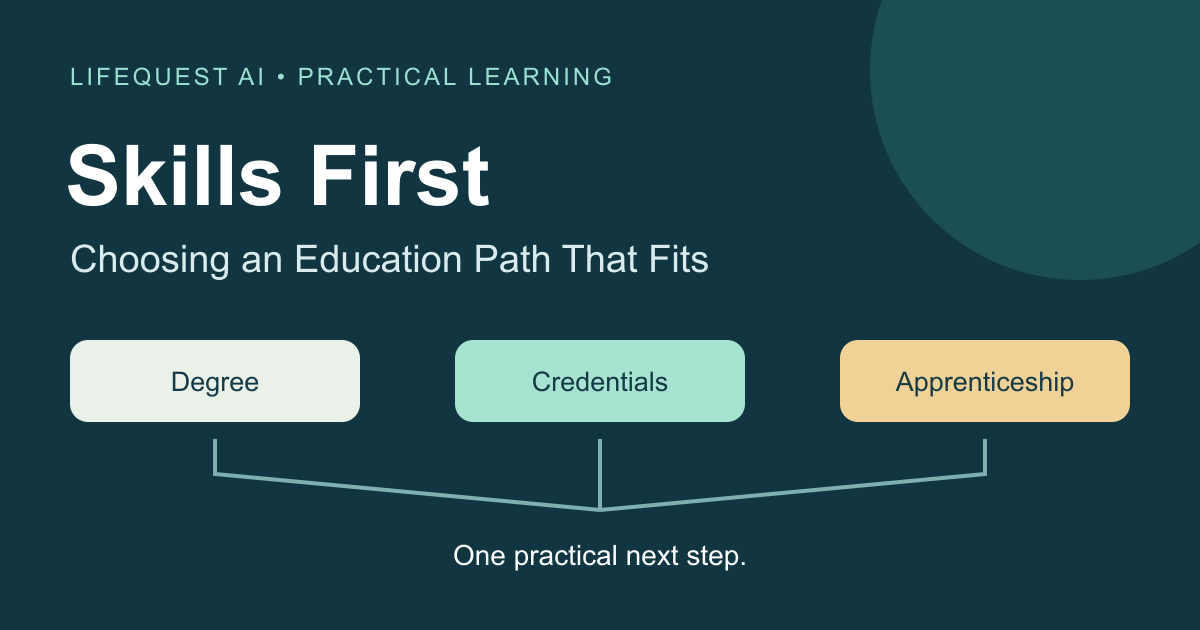
Then compare realistic routes: a degree, community college, an industry certification, or a registered apprenticeship. Some routes can be combined. Registered apprenticeships offer paid work alongside instruction, with a recognized credential on completion. Explore how apprenticeships work.
Check what each credential actually represents. A course-completion certificate, an industry certification, a degree, and a professional license are different things. Before paying for a program, verify entry requirements, exam costs, renewal requirements, and whether employers in your target area recognize it.
Degrees also retain economic value. BLS data show higher median earnings and lower unemployment for bachelor's degree holders than for high school graduates in 2025. Those national averages are not a forecast for an individual student, and they do not isolate apprenticeship outcomes. See the BLS data and limitations.
Make AI fluency a practical skill
Practice using AI on a small task connected to the work you want to do: explain an unfamiliar concept, draft a customer response, or organize a set of sample notes.
Check the result against reliable material. Record the time spent prompting, reviewing, and correcting it. Keep an example that shows both the finished work and your judgment.
A useful learning goal is being able to define a task, provide context, check the output, and improve it. Treat any claim of guaranteed speed or job security as something that needs evidence.
Try this research prompt
I am exploring [role] in [location]. Using the job postings and program information I provide, compare a degree route, a credential route, and an apprenticeship route where available. Show required qualifications, total known costs, duration, practical experience, and unanswered questions. Cite the supplied sources. Mark missing information as unknown. Do not invent salary, placement, or licensing claims.
Take one small next step
Before making a major commitment, compare two programs, speak with someone doing the work, or complete a small practice project. Include learning format and available support in the comparison. If you are already enrolled, check deadlines and consequences with the institution before changing your enrollment.
Choose a route you can explain: the work it prepares you to do, the evidence behind it, and the next step you can afford to take.